Branch 50th Anniversary - Early History
Campaign for Real Ale Mid-Glamorgan Branch 1976 to 1996
As we celebrate our 50th year, we have been looking back over our history. Bill Roberts, who was there at the start, tells us how it all began....
Introduction
L.P. Hartley’s comment that ‘the past is a foreign country; they do things differently there’ (The Go-Between, 1953) is apt in considering the early history of the branch, as there are striking differences in what was happening in the world of British beer between this period and today. As the only founder member of the branch still directly involved, ‘I know, ‘cos I was there’ (Max Boyce, passim) is, I hope, equally appropriate to my offering to write a review of branch activities over this period. I have aimed to provide a reasonably comprehensive summary of activities and the context within which these were undertaken. I have used data from national and local publications (notably Real ales in South and Mid Wales (1981) and The South Wales Beer Guide (1985), assorted ephemera, personal diaries, recollections and the occasional anecdote, while Google has been useful to check dates and other stuff. I begin with a personal anecdote.
On 6 June 1973 England were playing Poland in a World Cup qualifier. It was televised, a rare event at the time, and I passed a sizeable group watching it in a shop window on my way to the Red Dragon Bar, at the front of Cardiff General Station. At around 8.30 p.m., I was drinking a pint of Double Diamond and to misuse their slogan, it did do at least one wonder: I wondered why I was not really enjoying it, and that there must be something better to drink than sweet, fizzy beer. I suspect that few others can pinpoint an equivalent experience to within minutes. Shortly after this, I was in the Butcher’s Arms in Rhiwbina, bemoaning the general quality of beer with a colleague, compared with the lunch-time pint he had advised. We were approached by Bill Reid of Cardiff branch who had overheard us, and this was how I was introduced to CAMRA (Campaign for Real Ale).
Brewers and pubs
At the time, around 80% of beers on sale in Britain were brewed by seven companies (Allied Breweries, Bass, Courage, Grand Metropolitan, Guinness, Scottish & Newcastle and Whitbread). 56% of the UK’s 75,000 pubs were owned by six of the above, Guinness being the exception. National keg bitters, e.g. Allied's Double Diamond, Bass's Worthington E, and Grand Metropolitan's Watneys Red Barrel were increasingly dominant and strongly promoted. Most of these companies had several breweries. There were also eighty-plus regional or local independent brewers, which also owned their own pubs, but these were not commonly known outside their home area. Lager had not yet achieved its later popularity.
The situation in Mid Glamorgan illustrated the national picture. In 1976, there were two breweries in Mid Glamorgan. Rhymney Brewery (Whitbread), which was closed in 1978, and South Wales Club, later known as Crown Brewery), in Pontyclun. This became Crown-Buckley for six years and was then taken over by Brains and closed in 1989. Whitbread’s Rhymney and Ely Brewery, Cardiff (closed 1982) brewed the same beers: a light bitter and a dark mild, which were nearly all pressurised. Their often pink, pubs were a prominent feature in the area, and in 1985, they had forty-eight tied houses in Mid-Glamorgan, and a similar number of non-tied premises, with one or more of their beers. Cardiff-based Welsh Brewers (part of Bass Charrington) had a similar number of outlets for its two bitters and dark mild. The brewery was sold to Brains in 1999). Brains beers were available in a number of outlets, mainly tied houses, most of which were near Cardiff. The South Wales Clubs beers were sold in a few pubs, but most went to around a hundred of its 350 member clubs.
The number of Mid-Glamorgan pubs in which various brewers’ beers could be found (The South Wales Beer Guide, 1985) is as follows. Most will be familiar to older drinkers, while some names have not been seen for many years, often following takeovers. Afan and Gwent were among a few small brewers, both producing high quality and popular beers.
- Whitbread: 95
- Welsh Brewers/Bass: 90
- Brains: 37
- Courage: 20
- Usher: 16
- Ansell: 9
- Felinfoel: 7
- Afan: 4
- Crown: 3
- Marston: 3
- Youngers: 3
- Robinson: 2
- Buckley: 1
- Everard: 1
- Fuller: 1
- Gwent: 1
- Sam Smith: 1
- Wadworth: 1
Given the facts and figures at the national level, a small number of people started to become concerned. The Society for The Preservation of Beers from the Wood had been formed in 1963, and CAMRA in 1971 as reactions against the trend away from draught beer (‘real ale’, was a CAMRA neologism, adopted early in the Campaign for the Revitalisation of Ale’s history). Richard Boston wrote his first weekly Boston on Beer in The Guardian 11 August 1973, the first national column that took beer and the threat to traditional styles seriously. He frequently wrote about CAMRA and recommended Frank Baillie’s The Beer Drinkers Companion published that year, as did the first, very basic, CAMRA Good Beer Guide. I bought Baillie’s book, which was the first to include details of all UK brewers, the breweries and beers, and remained a valuable guide into the 1990s, and is now a clear reminder of the overall situation of beer over the period. I also picked up a copy of the first Good Beer Guide in Lear’s bookshop in Cardiff, but at 75p, if I recollect correctly, for which I could buy six pints of Courage AK, with 3p change, it seemed too expensive. Oddly, given all this, it took me two years to join CAMRA as its 3000-something member.
Foundation of the branch
Changes in local government areas in Wales in 1974 created a new county of Mid Glamorgan which, in addition to the current area of Rhondda Cynon Taf and Merthyr Tydfil, included what are now the counties of Bridgend and Caerphilly. This remained the situation until a further reorganisation in 1996. For geographical convenience, Caerphilly has remained within the remit of the Mid Glamorgan branch.
A branch had been set up in Merthyr Tydfil, a year or so earlier, and in an effort to extend campaigning throughout Mid-Glamorgan, South Wales Area Organiser, Phil Gibbins invited local members to meetings in four pubs in February and March 1976. These were the Otley Arms (Treforest), the Castle (Bridgend), the Anchor (Merthyr Tydfil) and the Castell Mynach (Mwyndy). There was enough interest at these meetings, and the Mid Glamorgan branch was established shortly after. A subsequent letter from the new Mid Glamorgan branch chairman, Alun Morgan, is too faded to include. It listed events including a general meeting at the Otley Arms, 12th April 1976, the first official Mid Glamorgan activity. Other activities listed over the next few weeks included a skittles match against Cardiff branch and the first ever day out, which was to Usk: ‘Robinsons, Felinfoel, Davenports etc.’. Phil and Alun were the driving forces in the branch during its early years. I took over as Chairman in 1978, alternating with Geoff Earlam every few years until the early 1990s. Phil attended the 40th anniversary meeting at the RAFA club (Bargoed).
Meetings
In most months in the earlier years there were several meetings, one of which was concerned primarily with business, and the others with socialising. The attendance varied, as the membership was widespread, but there were about twenty-five seriously involved, with the majority living in the Bridgend and Pontypridd areas. Until 1978, the Regional Organiser, Dave McKercher, came to business meetings quite regularly, and as he lived in Reading, this was certainly conscientious. His successor, Gordon Saunders of Cardiff Branch was equally involved. Other meetings combined socialising with campaigning, including talking to the licensee and, where it seemed appropriate, customers, about CAMRA and its aims. Between 1976 and 1996, meetings were held at around a hundred and twenty pubs, some of which became a regular option, notably the Otley Arms, Treforest (14 meetings) and the Castell Mynach, Mwyndy (8), both of which hosted several AGMs. Others with ten or more meetings were the Bunch of Grapes Pontypridd (10), the Taffs Well Inn, Taffs Well (10), and the White Hart, Machen (11). A number of afternoon meetings were held in the summer months, often at seaside locations. However, a substantial amount of campaigning, on both an individual and larger scale, was also undertaken. The first two Annual General Meetings were held in the Tŷ Newydd Hotel, Hirwaun. Both followed a dinner, with the first AGM being remembered as being completed between the cheese and the biscuits.
Things did not always go to plan. Notable evenings included our being refused entry to a Bridgend pub, with ‘I don’t want your sort in here’ being the welcome from the licensee. He had a reputation for being a bit blunt. Missing the last bus was also a hazard, and two members were renowned for having slept under a hedge in Maesteg in one such a situation.
Campaigning
This was the most important activity in the earlier years, and most members were young, idealistic and enthusiastic. Apart from pubs where meetings were held, members visited around two hundred others, and details were recorded. Where possible, we aimed to speak to the licensee and promote what CAMRA was about. In general, we were reasonably well received, with occasional total lack of interest, and the odd antagonistic response. If the licensee was not around, we generally took just notes. On one occasion, the licensee appeared as I was taking notes, and he was relieved that I was not from HM Customs and Excise. Ticks in The South Wales Beer Guide show that I visited 205 of the 312 listed, either specifically for campaigning, or as likely, just for a pint and a tick.
 In addition to engaging with licensees and customers, less direct but more widespread campaigning was to provide national and local printed information in as many pubs as possible. Malt & Hops, a simple printed twelve-page magazine was produced by local branches (led by Cardiff) in the late 1970s and early 1980s. An example from 1978 is included in these Branch History Documents and Images .
 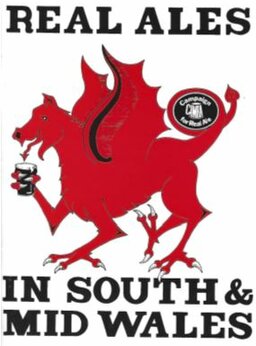 Branch members, including some who later joined the branch, also contributed to Real Ales in South and Mid Wales (Geoff Earlam) and The South Wales Beer Guide (Paul Burgess, Geoff Earlam, Bob Hagarty, Margaret Lovett, Martin Lovett, Jeff Mobley, Hugh Rees, David Thomas and Bill Wooley),
 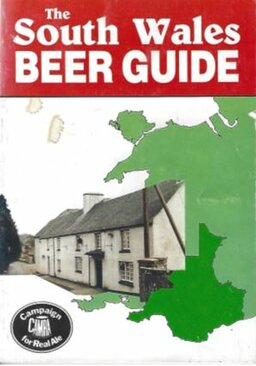 both publications selling reasonable numbers. All branch members could get involved each year in surveying and deciding on pubs for inclusion in The Good Beer Guide, but most was undertaken by regularly active members. However, the most active local campaigning was through public events, specifically beer tents at local horse shows and larger scale beer exhibitions; the term ‘beer festival’ had yet to become the usual name.
Events
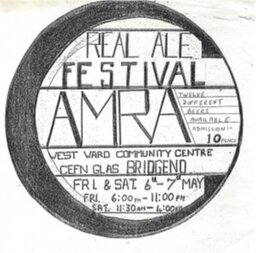
The branch’s first public event was a beer exhibition at the West Ward Community Centre, Bridgend, 6th – 7th May 1977. A handwritten foolscap (precursor of A4 for younger readers) poster advertised twelve different beers and 10 pence admission. The novelty of the event was recognised by the Bridgend Observer, providing a useful summary of the range of beers available (‘sixteen kilderkins or 2304 pints’), with Phil Gibbins commenting that ‘we hope to introduce people in the county to real ale available here and to some which is available nearby’. Some five hundred people were expected and there was certainly a good turnout. Cardiff Morris, of which Phil was a member were invited, and were also at some subsequent events.
A similar event was held at the Grand Pavilion, Porthcawl on June 18th.1977. The next event, at Aberdare Sports Centre in February 1978, was the first with professionally printed posters, advertising ‘3000 pints of real draught beer [with] 16 different traditional Welsh and English brews’. Entrance was 15p. As it was in a venue with its usual activities happening at the same time, the logistics of delivery and setting-up of the beer were more complicated than in Bridgend, but it was well-attended, and a similar event was held there in 1980. The beers on offer were virtually all local, and the odd beer from further afield was probably unknown to most of those attending.
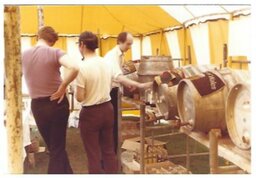
A beer tent at the Llantwit Fardre Horse Show in mid-July became an annual event for us between 1979 and 1983, initially in Central Park, Church Village, and the last two in a field near Talbot Green, and for various reasons, the show was discontinued after that. As the event involved a bar being set up in a marquee a day or two before the show, to allow beer to settle, it had to be guarded throughout this time. Fortunately, members of Llantwit Fardre RFC helped out, with the night guard bringing his German Shepherd. The licence for the bar was taken out by Alf Otley, licensee of the Otley Arms, for which we were very grateful. The beers on offer continued to be the same sort of options as in pubs, as there was no alternative. The success of the bar led to a similar set-up at the Porthcawl Horse Show in 1981 and 1987.
As with meetings, there were a few unexpected happenings at events. They included the (off duty) Weights and Measures man, who noted that we should not be using some of our pint glasses, which lacked the appropriate markings. We tried to be careful subsequently. There was the (on duty) local policeman, who was a little over-keen in helping us check the beers before opening time. A personal memory is the slightly tipsy local TV presenter (he had been elsewhere, earlier) who gave me a ‘Do I know you from somewhere?’ look, and I thought it polite not to say that he had interviewed me the week before, regarding a work-related press-release I had sent out. Perhaps the trickiest was the pin (36-pint barrel) set aside for the winners of a tug-of-war, which somehow had several pints drawn and sold in error. Having to top it up was awkward and time consuming, and there was almost as much spilt as went in. The winners never knew.
CAMRA’s Annual General Meeting was held at Cardiff University in 1978, and I and several other members attended, with around 500 others from across the UK. Some branch members worked in the beer exhibition, which offered local beers. The South Wales Echo had a sizeable article on it, noting that the public were invited to the exhibition for 50p.
Branch members also supported pubs in setting-up beer festivals in the late 1970s and early 1980s. The Welcome to Town, Bridgend and the White Hart, Machen continued with festivals for several years. We also supported Llantrisant Round Table with their early beer festivals, at the Wheatsheaf, Llantrisant, in the late 1980s.
Visits outside the branch area
Day trips included a Cowbridge walkabout, several to Talybont-on-Usk, and further afield to Wye Valley Brewery (then at the Barrels pub in Hereford) and Chepstow Beer Festival in 1991, a Bristol walkabout in 1992 (my first visit to a Wetherspoons), and the 1993 Mid Wales Beer Festival, Neuadd Arms, Llanwrtyd Wells, notable for the increasingly heavy snow on way back. A weekend trip was arranged to Helston in autumn 1988, memorable at the outset for the hired minibus being filled with petrol, before someone realised it should have been diesel. Everything was unloaded and cars used instead, and despite my having to drive, it was fun when we got there. I vaguely remember singing Admiral Benbow, and some other favourite folksongs in the Blue Anchor; the 5% Spingo tended to loosen the tongue. The Black Country weekend in autumn 1990 was just as good, including the locally famous Delph Road Run, in Brierly Hill, which passes Batham’s Brewery and two of their pubs, which among several others lived up to expectations. At least, I presume it did; things can get a bit hazy.
National AGMs and Great British Beer Festival
I attended the 1979 AGM at Keele University, and later ones in Reading, Southampton and Birmingham Universities, as branch representative I volunteered to work at the 1981 Great British Beer Festival in Leeds, the first to be held outside London. I was on the bar on the first night and had the unexpected honour of pulling the first official pint for John Charles, who opened the event. Best known for his time with Leeds and Juventus, and his international career with Wales, and still considered by many as the greatest ever Welsh footballer, he was then licensee of a local pub. He agreed with me that pint of Landlord was an appropriate choice. I spent the next few sessions in the kitchen, which most people tended to avoid, as drinking was banned, but you made up for it afterwards. It was also a memorable weekend for a mishap and a near mishap: I got locked out of the Leeds University hall of residence and had to knock on several windows to get in, and a friend from college (from Newcastle, last seen in Kent) stepped out in front of my car. His iffy eyesight had possibly deteriorated, as he did not recognise me, and I could not stop to say hello. Fortunately, the crate of beer from Penrhos Brewery (co-owned by Terry Jones of Monty Python and Richard Boston (see above), survived the emergency stop. Geoff Earlam might not have appreciated my excuse if his half of the crateful had not arrived safely.
Copies of Phil Gibbins’ initial letter, various items relating to events, and covers and extracts from publications are shown in the below document. The quality of some copies is not ideal, as the originals are somewhat faded, but taken together, they provide an interesting reminder of what was around at the time, and what is still around.
Branch History Documents and Images
Bill Roberts, April 2026